Camelot Wheel & Harmonic Mixing Guide for Psytrance DJs
How the Camelot Wheel works, six harmonic mixing techniques you can use, what my database of tracks reveals about psytrance keys, and answers to the questions I hear most.
Harmonic mixing techniques
The Camelot Wheel gives every track a code like 8A or 9B: a number (1–12) for its position on the circle of fifths, and a letter for minor (A) or major (B). Tracks that are close on the wheel share harmonic content and are compatible in theory. Beyond the classic "stay on the same number, or move ±1" rule, Mixed In Key documents several named techniques for moving further around the wheel on purpose:
| Technique | Move | Effect |
|---|---|---|
| Same key | +0 | Perfectly safe, no harmonic shift at all. |
| Adjacent | ±1 | The classic harmonic mix: subtle movement, always compatible. |
| Relative | Same number, other letter | Same notes, shifts the mood between minor and major. |
| Energy Boost | +2 | A quick lift in energy. Use sparingly. Too much feels jarring. |
| Jaws | −5 | A bigger jump, nicknamed the "Armin van Buuren variation." Best at a planned transition. |
| Pay Attention | −3 / +9 | A dramatic shift for peak moments, meant to be noticed. |
Every one of these techniques is built directly into the track search. Click the ≈ button on any result to browse harmonically compatible tracks at a matching tempo, filtered by whichever techniques you want to explore.
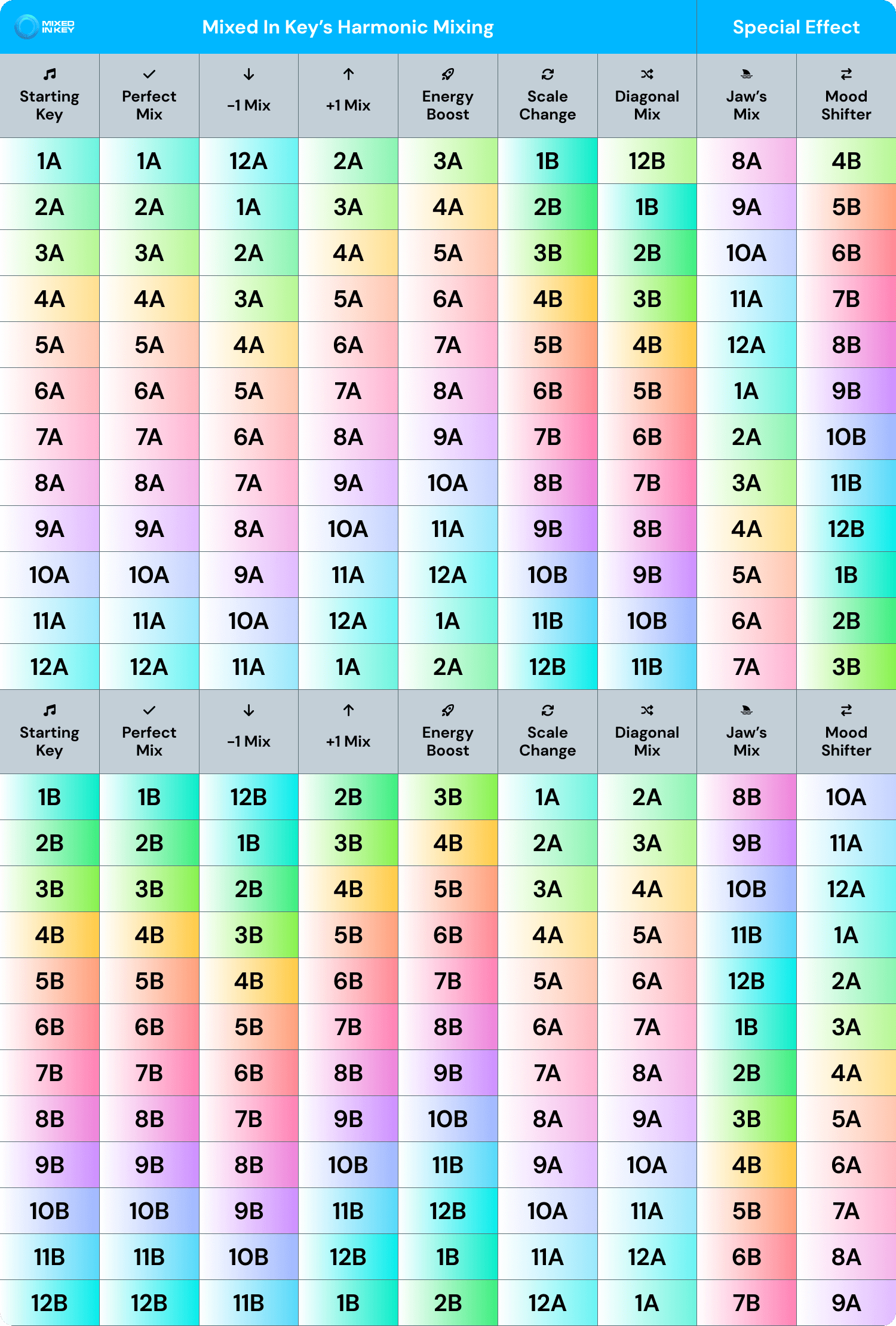
The full wheel: which keys are compatible with which.
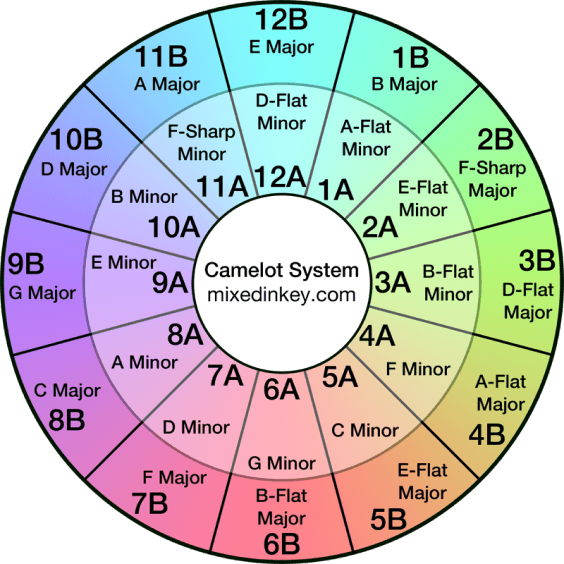
Camelot notation translated to traditional musical keys.
What my psytrance key data reveals
I analyzed the key distribution across my database of over 44,000 psytrance tracks, all processed with Mixed In Key. A few things stood out:
That minor-key dominance is practically a genre signature. Psytrance leans on the darker, more hypnotic character of minor tonality to sustain the driving, trance-inducing feel the genre is built around. Major-key tracks exist, but they're rare enough that stumbling on one is worth noting.
I also found that Mixed In Key's analysis has a hard limit: tracks longer than roughly 17 minutes simply can't be analyzed and never make it into the database at all. For the current, always-up-to-date numbers (they shift as the library grows), see the live Stats tab on the search page.
Frequently asked questions
What is a Camelot key?
The Camelot Wheel is a notation system created by Mixed In Key that maps every musical key to a number (1-12) and a letter (A or B). A keys are minor, B keys are major. Numbers represent position on the circle of fifths, so tracks with close or matching numbers are harmonically compatible and mix well together.
What's the difference between 8A and 8B?
The number stays the same, but the letter changes. 8A (A minor) and 8B (C major) are relative keys: they share the same notes and key signature, just built from a different root. Mixing between them (the Relative technique) keeps the same harmonic content while shifting the mood between minor and major.
Why is almost all psytrance written in a minor key?
Across my database, 99.5% of tracks are in a minor (A) Camelot key, and only 0.5% are major. Most psytrance is written in minor keys or minor modes because they naturally create the dark, hypnotic, mysterious, and emotional atmosphere that defines the genre. Common scales are natural minor, phrygian, phrygian dominant and harmonic minor to name a few.
What is Energy Boost mixing?
Energy Boost means mixing into a key two numbers higher on the wheel, for example 5A to 7A. It's a quick way to lift a dancefloor's energy mid-set, best used sparingly since overusing it can overwhelm the crowd.
What are the Jaws and Pay Attention mixes?
Both are more dramatic harmonic jumps. The Jaws mix drops 5 numbers (for example 8A to 3A), nicknamed the Armin van Buuren variation for how he opens sets with it. The Pay Attention mix shifts -3/+9 numbers (for example 8A to 5A) and is best saved for peak moments where you want the crowd to notice the change.
Why doesn't the BPM shown always match Rekordbox?
Mixed In Key's "Restrict range" feature can halve the detected tempo of very fast tracks, for example storing a 184 BPM hitech track as 92. I cross-reference Rekordbox's re-analysis where available to show the true BPM, but a small number of tracks may still reflect the original Mixed In Key value.
How is this database built, and why trust the keys?
Every track here comes from my personal, actively maintained collection and is analyzed with Mixed In Key, which in my experience delivers more consistent key detection than Rekordbox or Beatport. Full details are on the About page.
Can I use this to find similar tracks for mixing?
Yes, every search result has a "≈" button that surfaces other tracks in a harmonically compatible key and a close BPM range, using the same mixing techniques explained above. It's a fast way to discover new material that'll work in your set.